
What gives, and how can it change?
By Collyn Wright, TMN Editor-in-Chief
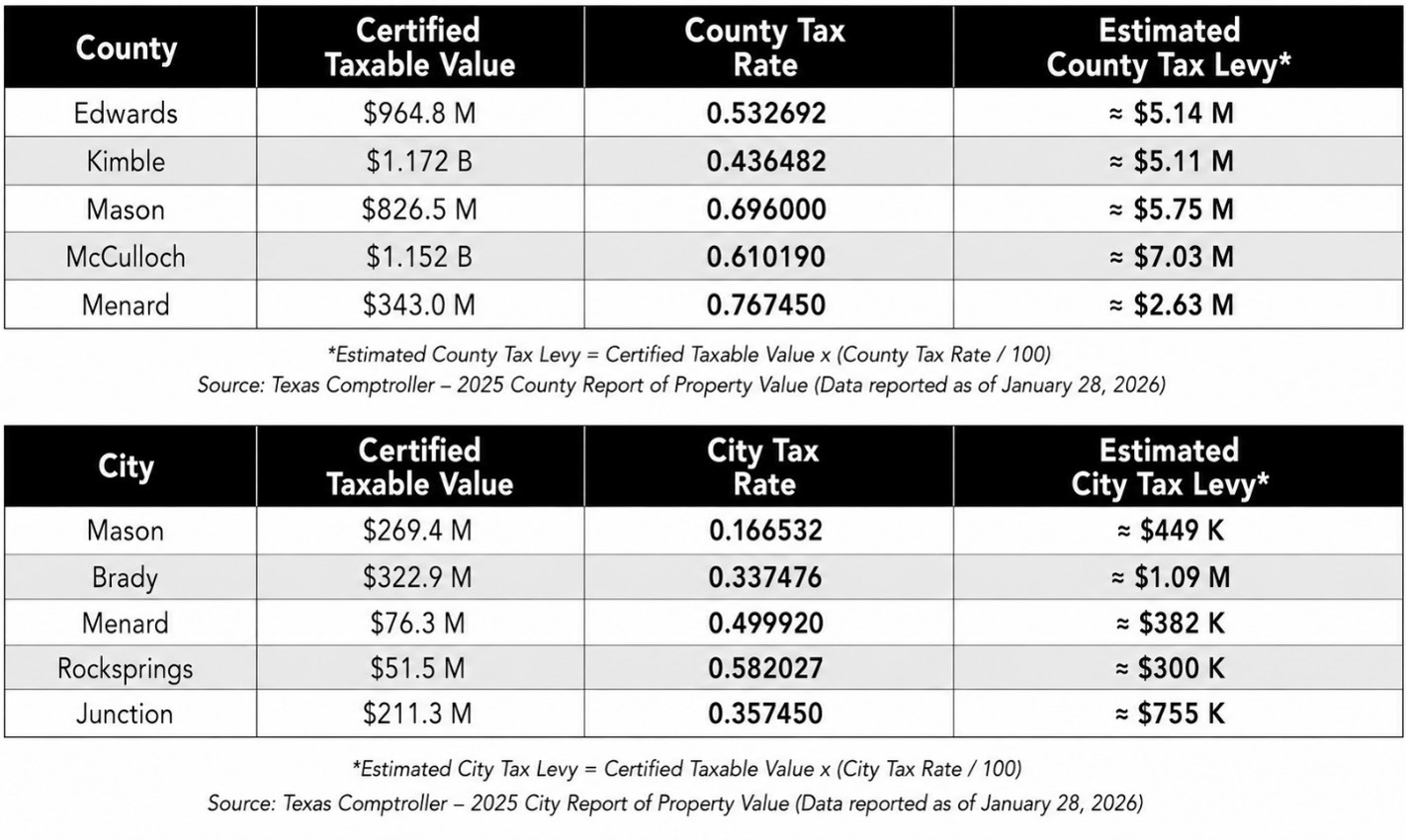
Menard County adopts one of the highest property tax rates but generates the least amount in property tax revenue in the region. Why is that? Simply put, Menard County has significantly less taxable property value than that of our neighbors. Our neighboring communities boast industrial, commercial, and energy developments- all of which add high value to their tax rolls. Even taxing property owners at a higher rate per $100 value, Menard taxiing entities STILL earn less revenue than our neighbors via property tax payments. Low property valuation means Menard County taxing entities have less tax base to support roads, public safety, infrastructure, and necessary services.
For instance, Kimble County (Junction) earns the closest revenue to Menard County with a tax rate of .436482 versus Menard’s .767450 per hundred. Kimble’s county property tax rate is .330968 cents per hundred lower than Menard’s, yet they earn 48% more property tax revenue based on the larger the property value in Kimble. Their property value is $1.172 billion dollars compared to Menard County’s $343 million.
The same thing goes for the City of Menard tax levy. Except for Rocksprings, Menard has a higher city tax rate than our peers, but the certified taxable valuation within the city limits is also low; therefore, the revenue is less.
For instance, the Mason City rate is .166532 versus the City of Menard at .4999200. Menard taxes its property owners within the city limits .333388 more in city property taxes per 100 but earns $67,000 less than Mason city tax revenue because Mason’s certified taxable value is $269.4 million compared to Menard at $76.3 million.
Check out the chart to see where we stack up against the counties in the 452nd Judicial District. Generally speaking, when the certified taxable value in a county is high, the tax rate is typically lower.
Many suggestions for increasing Menard’s taxable value have been proposed, but when looking at the numbers, the majority do not make sense for our unique situation. Adding population to the community with additional housing and businesses could help slightly; however, the budget shortfalls would remain without the added value of the energy development sector. Taking the top 10 businesses in town, with parts stores, restaurants, general shopping, groceries, and convenience stores included, adding up their total property tax payments for 2025 and dividing it by 10, the average business spend was around $6,175 in property taxes, per year. That average of $6,175 for the largest footprint businesses then must be divided amongst all the tax entities by their tax rate per hundred. Of course, some businesses spend less, and some spend more. The lowest amount of property tax revenue in the sample was $3,665, the highest being $21,905, with most in the $4,000-7,000 range. It would take a lot of businesses and new growth to make a significant difference in the tax base through business property taxes alone.
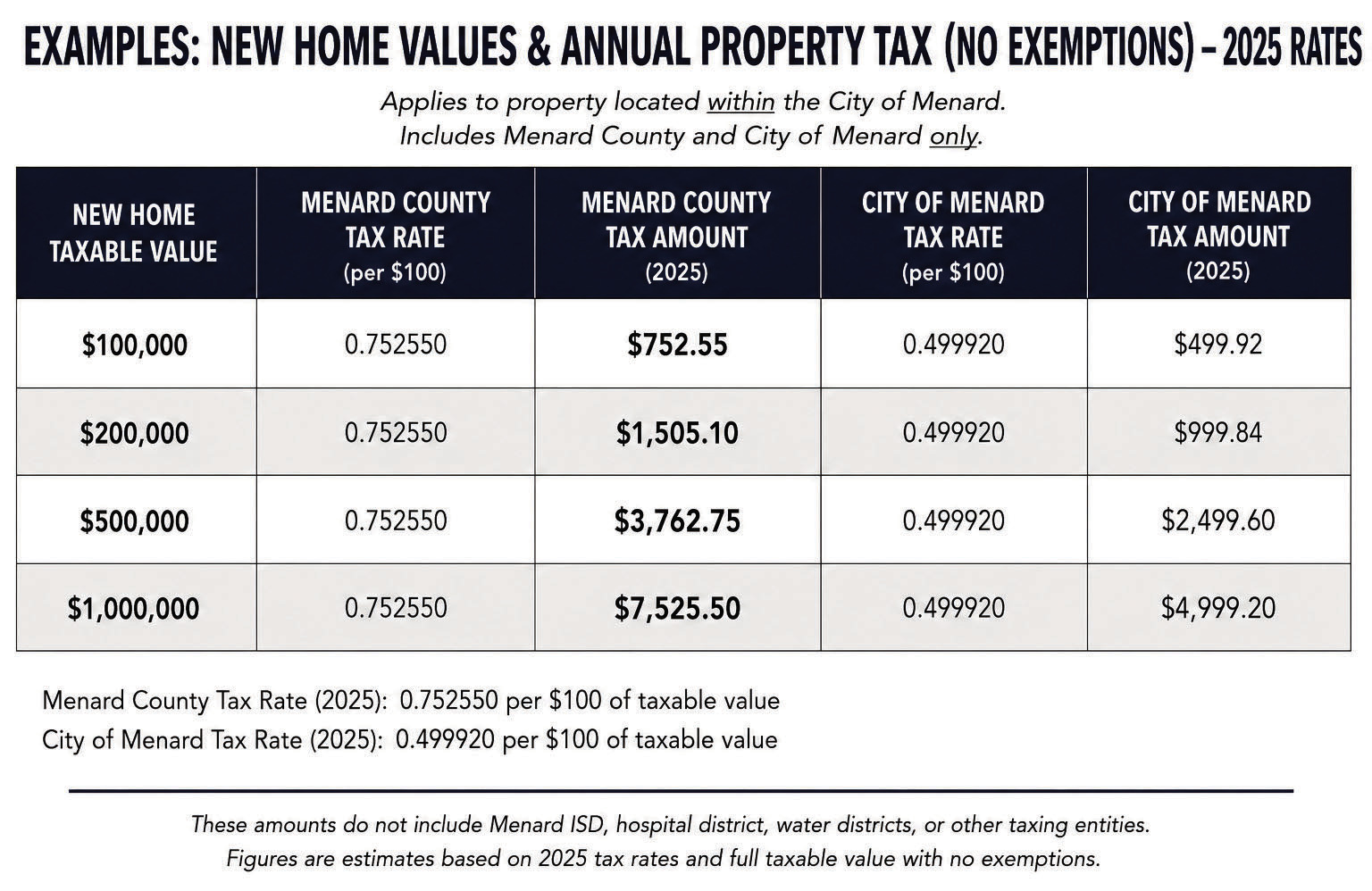
See the chart below of estimated property tax amounts based on generic property values with no exemptions, to keep it simple. It would take quite an influx of population to significantly improve the tax base through new builds. How many potential property owners could afford a million dollars-plus buildouts to maximize the tax value growth?
The answer cannot be found by increasing existing property valuations, either. It was suggested by a commissioners court attendee that the appraisal office increase all property values-- more than what the state already requires. Currently, property owners are strapped by higher than regional tax rates. Adding more burden to local property owner’s bottom line does not solve the problem, it creates more problems.
Menard County is listed as one of the lowest 10 counties in Texas for taxable property values. A strong tax base is what funds infrastructure, law enforcement, county/city roads, and essential services. The services, maintenance, and repairs the city and county can provide on a shoestring budget is remarkable. Increasing the county’s overall taxable property value does not appear to be found in building housing, adding to the census, and bringing in bringing in businesses the relative size of our current businesses. The difference between Menard County and the surrounding counties appears to be the ability to adapt and change, using smart growth with an investment in the future.