
BEFORE YOU START:
> The property owners of the proposed BESS facility are Menard News publishers Tyler and Paige Wright. Tyler is also a county commissioner who, if the Court is ever faced with a decision on this matter, will not participate, as per normal protocol. Contributing writer and Editor of The News is Collyn Wright, who is of no familial relation to Tyler & Paige but is an employee.
> There is no required vote from any entity to approve or deny the sale of private property or construction of a BESS facility.
> If the project developer determines they will request a tax abatement at the appropriate time, the county commissioners are who makes that decision... without Tyler.
> This is a lot of info and we have so much more. Everything contained on these pages is fact and has come from verifiable, legitimate sources such as published EPA studies or established data reports.
>This information has been compiled over a few months as we have dived deep into the as property owners and much of it recently as community concerns are voiced.
> Everything on these pages is presented in good faith as a basic learning resource.
TMN is not responsible for reader miscommunication/ misunderstanding or typographical errors and is not meant to be considered the policy of any entity involved.
The following feature is a TMN compilation to assist readers in understanding an extreme amount of technical data on what BESS is, what it is not, and determining researched proven fact from fiction. The information contained is from three writers: Collyn Wright, Paige Wright, and Carl Laning, none of whom are experts on the topic yet have dedicated many hours to locate factual information. Mistakes are imminent with this much information and errors will be promptly corrected.
The Monday, November 10, 2025, Menard County Commissioners Court meeting agenda item #15 was a preliminary introduction of the proposed project by the developer and is mentioned within this text. With many concerned citizens in attendance, the Court allowed a more liberal amount of public comment than usual in order for everyone who desired to speak. You can view the three-hour item #15 recording here: Menard County Commissioners meeting; November 10, 2025; agenda item 15, BESS presentation.
Some local concerns on the potential installation of a BESS facility in Menard County include:
“Our property values will plummet, and our land won’t be worth a nickel!”
“These sites are dangerous and will cause mass evacuations!”
“What if a northbound airplane veered off and crashed into it?”
“I am just against green energy.”
A couple of quotes in response to some of these concerns, as sourced from professionals:
“There have been no noticeable decreases in property values within [Concho] county’s land market, despite the wind turbine farms.” -Concho County Chief Appraiser D’Andra Warlick
“There has not been a real-world battery event that showed hazardous levels of emissions. All fires create emissions that should not be breathed, including house fires and commercial buildings.” Independent safety expert Mike Nicholas “In my opinion when comparing the [proposed] facility to large LPG storage tanks, large pipelines and hazmat transportation, all which are currently in our community daily, the proposed BESS facility will be SAFE. The risk to benefit factor would lean to the benefit side.” - Menard County Emergency Management Coordinator Jeff Whitson
WHAT IS IT?
By Paige Wright
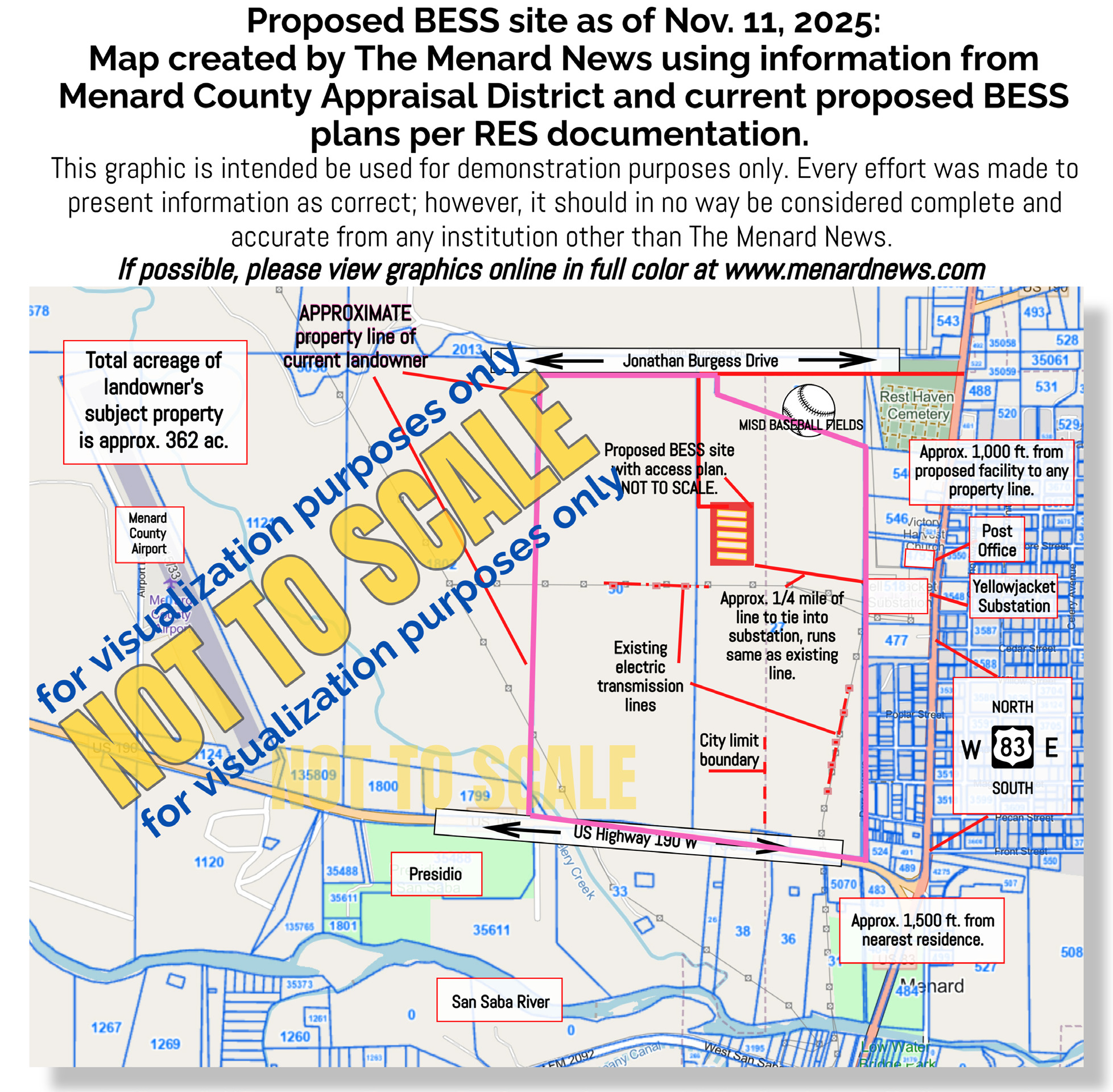
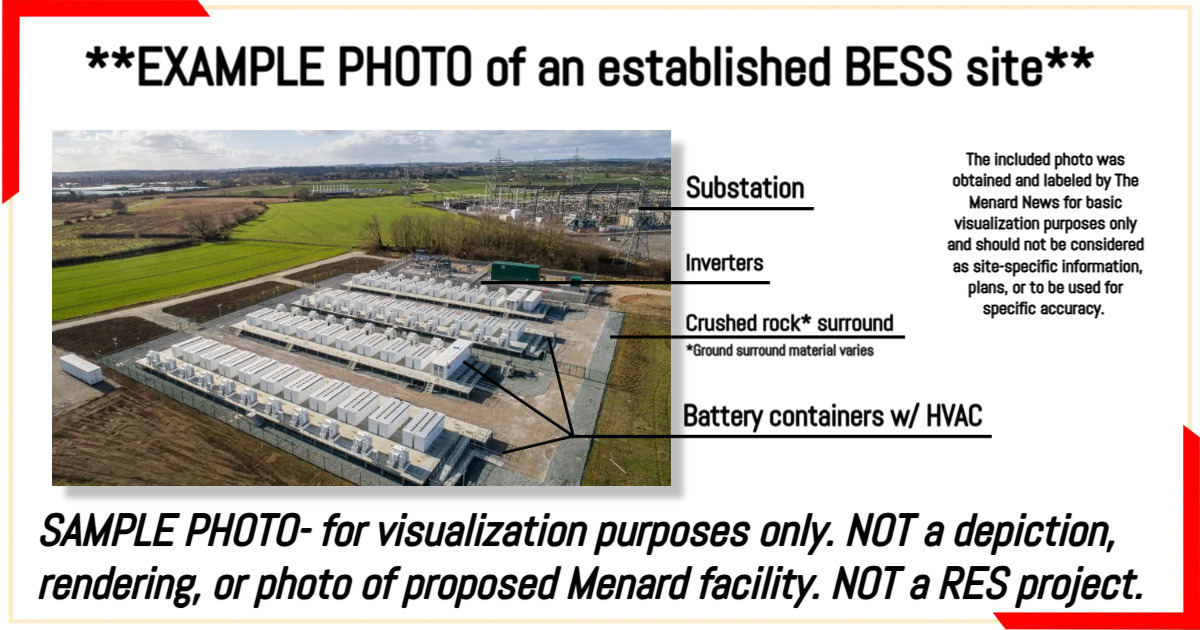
Battery Energy Storage Systems in general are a rapidly growing part of the energy sector that, put simply, house clusters of lithium-ion batteries designed to store already generated green energy with the intent of releasing stored energy to the electric grid during peak load needs and/or grid failures. The systems are typically located near electrical substations where they interconnect to provide a back-up of sorts, ready to deploy stored energy when the Texas grid is overwhelmed.
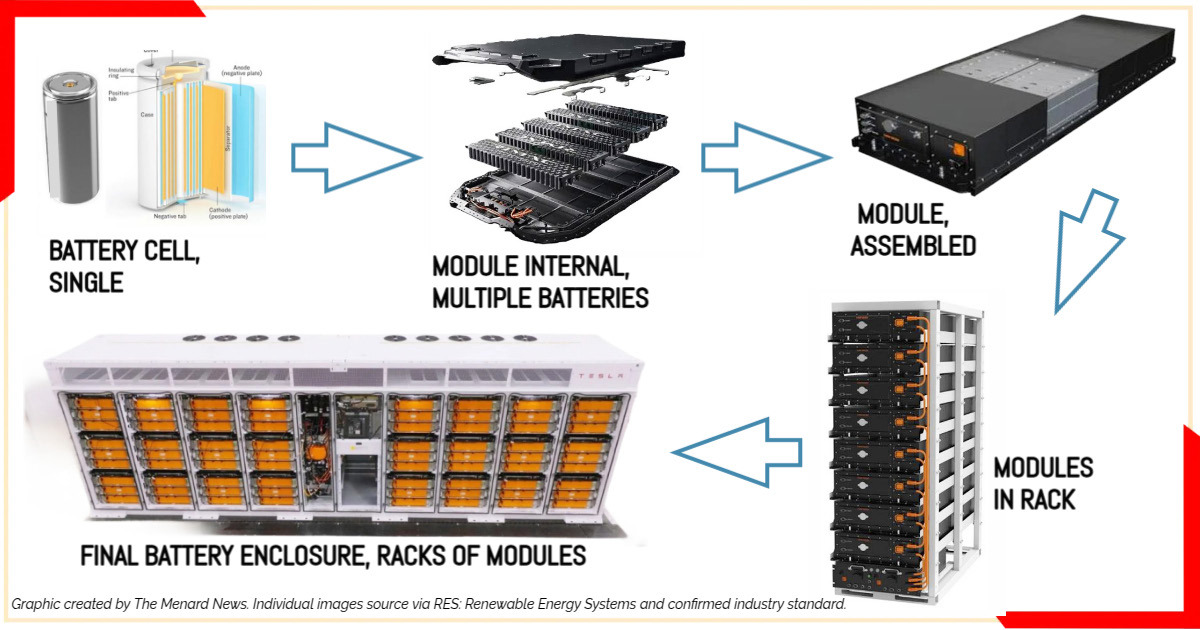
Types of BESS sites vary; however, the basic architecture of a site involves multiple single lithium battery cells placed into modules. Those modules are then placed in racks. The racks reside inside enclosures which make up the structures seen from outside the facility. See Figure 1 for container components. For reference, the final enclosures/containers are comparable to a metal “sea container” and should not exceed 12-feet in height per current RES proposed plans.
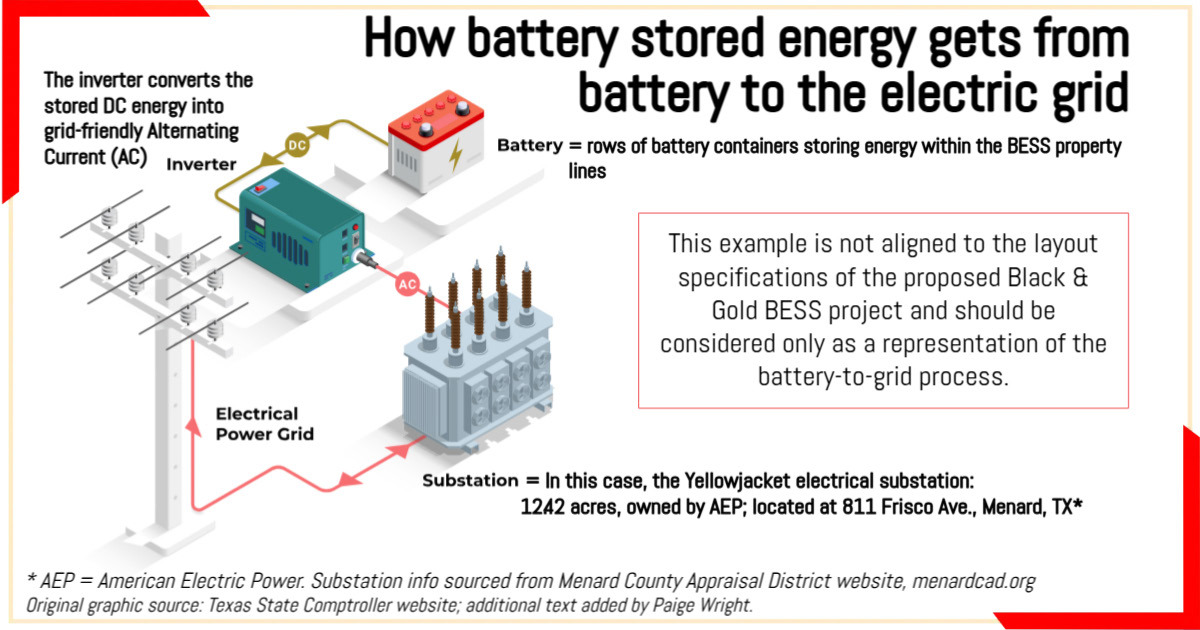
Although there is a significant amount of technical detail to the process, in general, the battery containers are connected to an onsite inverter that converts the stored DC energy into grid-friendly Alternating Current (AC). From there, the energy is transferred by a dedicated transmission line that ties into the nearby electrical substation where it can be pulled as needed. See Figure 2.
When called into action, a BESS facility reacts to changes in grid frequency extremely rapidly, typically within milliseconds.
WHY BESS?
Alternative means of safely generating, transmitting, and storing energy have been human interest since ancient civilizations noticed static electricity. Battery energy storage is still a fairly new technology. Utility-scale BESS roots go back to just the early 2010s. Some of the first systems were installed with lead acid batteries, like a car battery. That chemistry was proven to be misaligned to the need and proved to be costly in both maintenance and labor. To help stabilize electrical grids by providing steady power flow despite fluctuations from inconsistent generation of renewable energy sources and other disruptions. While BESS technology is designed to bolster grid reliability, lithium battery fires at some installations have raised legitimate safety concerns in many communities. Fueled by strategic shifts in the rapidly evolving energy sector and significant technological advancements coupled with decreasing costs of battery and construction components resulted in battery energy storage industry experiencing immense growth and improved safety in a relatively short time.
The lithium-ion batteries used frequently now were also utilized early on, desired for their extended lifespan, minimal maintenance, high energy density and low self-discharge.
The drawback of the LI batteries available at the time was fire safety. Although legitimate fire safety concern remains at the forefront, engineers have dramatically improved BESS failure rates by close to 97 percent. The global installed capacity of utility-scale BESS facilities has dramatically and continually increased over the last five years, and incident/ failure concerns have increased as well as more and more sites are being built.
While some incidents afflicting BESS sites have garnered significant media attention lately, the overall rate of incidents has sharply decreased. Between 2018 and 2023, the global grid-scale BESS failure rate dropped 97%. According to a 2024 report by the Electric Power Research Institute, the battery industry continues to engage in intense research and development to continue improving prevention and mitigation measures. The ongoing R&D includes development of a better understanding of the diverse causes of BESS failures. Essentially, the industry is adapting quickly to lessons learned from early failures and is continually incorporating new advances into the latest designs and best practices.
I scrupulously avoided social media of any kind and went to the EPA and Dept. of Energy (as well as state level equivalents), U.S. Fire Administration (part of FEMA), U.S. Energy Information Administration, Electric Power Research Institute, Fire and Risk Alliance, Power Engineering, Underwriters Laboratories, Western Electric Coordinating Council and more. I ignored any “clean energy” companies or promoters. Please remember, documented and reported are key words.
There are 858 utility scale battery installations in the U.S. as of this month. Texas accounts for ⅓ of all storage capacity nationwide spread over 161 sites according to the Comptroller’s Office. 49 sites went online in Texas in the last year alone. The total number rises to 1,000 plus if you include those in planning and development.
The number of ‘major fires’ is hard to nail down. Nationwide, ERCOT says 22 since 2019, the Fire and Risk Alliance says 35 since 2012. The Department of Energy notes 31 from 2012-24; however, there is no record of a fire or other major failure of any facility in Texas.
Nationwide there are no reported deaths related to a BESS incident of any kind. A total of 8 injuries have been reported, all first responders and all related to a single fire in Surprise, AZ in 2019. 4 were treated at the scene and released and 4 were treated at a nearby hospital and released according to the EPA and Electric Power Research Institute (EPRI). There have been complaints by neighboring residents of illnesses after several incidents but no link to a fire has been established by any agency or health provider so far.
The EPA as well as state and local agencies engaged in similar work take a keen interest in BESS fire events as you might imagine. In some instances, shelter in place or evacuations have occurred, “out of an abundance of caution.” According to the EPA, air quality testing done during and after fires has “found no risks to public health.” Inside the plume itself is a different matter, but no instances have been documented outside the immediate fire as it dissipates quickly.
Finding information on soil tests after one of the either 35 or 31 documented BESS fires is difficult. The Moss Landing site in California is likely the best studied. It is the largest BESS fire to date, Jan. of 2025. A third party, Terraphase, was hired by the site owners to take samples within a 10-mile radius. They were overseen by the California Department of Toxic Substances Control who took their own samples alongside as well at separate locations. 2,200 soil tests; 422 surface and pore water tests; 15,100 air measurements and samplings. The results show nothing unexpected or in amounts “above acceptable screening levels for human exposure." Except, at one location, 8 tests of a subset of 118 samples from a farmer's field showed lead, magnesium and cobalt were slightly above the norm. The lead part caused some head scratching as lead is not associated with battery fires. From 1950-1995 this site was an oil storage facility and industrial park. Many BESS sites are located on former industrial sites because of easy access to the grid and it's hard to know what went on there prior to BESS. Chicken or the egg. The entire report including some very handy summaries for those of us who don’t have advanced chemistry degrees is available at readymontereycounty.org There is a group of community organizers (self-described, their word, not mine) who are doing their own testing with some cooperation with UC Davis.
As for groundwater, there are no known instances of a BESS fire contaminating subsurface water. In East Hampton, NY in 2023 that exact scenario was a concern with the fire occurring essentially next door to the town water supply, a well pulling from an aquifer. For a time that was suspended but has resumed after testing showed no appreciable changes. Fire suppression runoff was the issue. The site had no ‘plumbing’ to direct the runoff anywhere else.
I am an historian by training and trade. With any new technology there is excitement about its potential but concern too. History does not predict, it informs.