
Please see our correction from Part 1 of this feature, clarifying some mis-stated information regarding the owners of the Mason County BESS facilities: Correction concerning Mason Co. BESS projects | The Menard News and Messenger
A few things to know and consider: The land (approx. 10-15 acres) considered in the BESS topic below is owned by Tyler & Paige Wright, publishers of The Menard News. Paige is the author of this article. Tyler is a County Commissioner, who, as per the norm, will be recused from any decision the Court may eventually be presented with. Conflict of interest in small community organizations is nothing new to involved individuals. We trust the leaders of involved tax entities to weigh the pros and cons of any issue and to properly recuse any potential conflict of interest as they see fit.
We took actual community concerns and got to the bottom of them!
CLAIM: Business owners, particularly the motel across from the post office, will have to close their doors because commercial insurance will 1. Not cover the business due to the proximity of 2,000 feet away from the proposed site, or 2., The rates will be so high they will be impossible to pay.
ACTUAL: We spoke with local insurance agents in Menard who verified that as of this time, not one of the carriers they use requires any information to be disclosed regarding proximity to substations, solar farms, BESS, and the like. Because we had the information handy, we checked in with the insurers of the news building. The public risk materials mention the company’s desirable arrangement for their insured properties to be from a BESS facility: at least 10 feet away from structures and at least 50 feet away from air inlets.
That same company also offers policies that cover the actual BESS facilities for the developer. If your commercial insurance skyrockets because of the proximity to a site, there are verified and affordable options locally.
SOURCE: Travelers Insurance company online; and local agent from an unrelated firm.
CLAIM: Not if, but when this site catches fire it will trigger mass evacuations and resident injuries due to the contaminated air. Also, BESS comes with far reaching explosion risk that threatens the entire county.
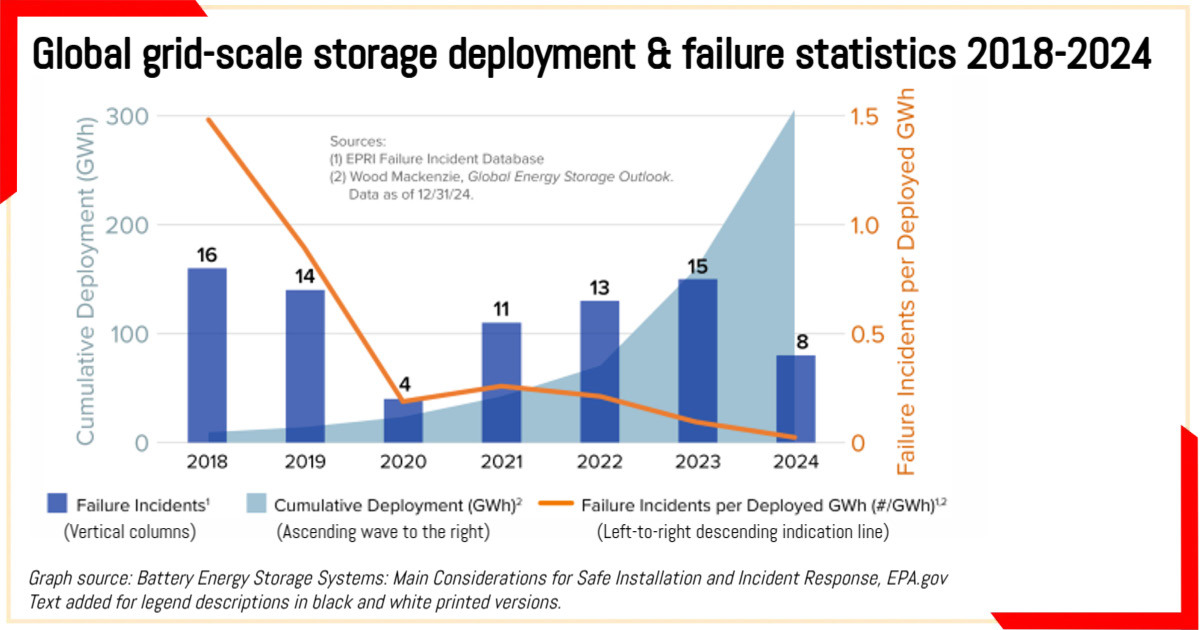
ACTUAL: A lithium battery in any application is subject to fire; however, it is physically impossible for the components of the proposed BESS site to trigger a noxious cloud capable of enveloping a large area.
BESS technology has come a long way in just the last 4-7 years and continues to evolve. As quickly as the industry grows and as many sites are established in our state, there has never been a fire or related incident in Texas. In the rare case of overheating, the system shuts off and disconnects any affected battery before a human can even notice and react to the change.
Mike Nicholas, an experienced and independent safety expert with Hiller Companies’ Fire Prevention Division, noted that if a battery (or many, were to burn) you certainly don’t want to sit around breathing it, but studies have shown air concerns in these fires dissipate quickly and are similar in toxic emissions to a regular house fire.
BESS installations must comply with strict safety standards including NFPA 70 (National Electrical Code) and NFPA 855 (Standard for the Installation of Stationary Energy Storage Systems), as well as a whole host of established and expected state regulations. These standards minimize risks by addressing fire safety, ventilation, and emergency planning. The developer currently has 19 operational BESS sites in Texas, with additional growth happening now. The safety record of these sites is clean within the company and across the state.
Evacuations of nearby residents have been implemented in some instances but is not a common response to this type of fire.
SOURCE: Mike Nicholas, Hiller Co., Texas Dept. of Insurance, EPRI.
CLAIM: If the project developer is granted a tax abatement, they will not have to pay property taxes until the abatement period ends.
ACTUAL: Property taxes, be it commercial, residential or utility, are subject to annual payment. An abatement does not mean the property owner does not pay taxes. An exclusion to that would be a 100% tax abatement, which is not being considered, and Menard County has never granted a 100% abatement.
The developer/owner must pay annually based on the property/facility value, which is not determined locally, but by the state Public Utility Commission (PUC). Upon potential purchase of the proposed 10 or so acres, the buyer pays taxes based on the value and tax rates at that time. Once the abatement period ends, the taxes must be paid in full, although by then the site will have depreciated in value. Regulations prevent the total value from dropping below 20%, so taxes paid will reach a minimum floor.
SOURCE: Menard County Appraisal District and Texas State Comptroller.
CLAIM: Because Menard ISD is a Chapter 42 district, the district will not receive any added tax revenue generated by the proposed facility.
ACTUAL: MISD is in fact designated as Chapter 42 by the TEA. While it could be true that MISD will not be able to keep all of the increased tax revenue, there are dozens of variables that are reviewed annually for the actual outcome, both by the TEA and the Comptroller. It is a long and complicated process that very well may result in the school district not benefiting as directly as it looks on paper. However, there are also options to collect related revenue in which other small schools have had success. As with most everything in this project, it is simply not far enough into the planning to come up with an educated figure. We have requests in with districts already in a similar situation and will publish those findings soon. Editor's note: You can see the follow-up to this concern here: Battery Energy Storage Systems in Menard: | The Menard News and Messenger
SOURCE: Texas Education Agency, Texas State Comptroller.
CLAIM: There are “at least a thousand other ways” for Menard County to generate this amount of income without risking the air we breathe.
ACTUAL: If someone would share with me just one of those 1,000 ways, I will be happy to spend time pursuing it because something has got to give if Menard is going to remain viable. Yes, there is a risk with BESS, but the few fires across the world using old technology have not proven elevated levels of air contamination after a fire. Many people have cited riskier instances we live with every day.
SOURCE: Self, who has been working to help fund our taxing entities and local organizations for years; the EPA.
CLAIM: The Menard News did not include information for a meeting held by an anti-project group on Thursday, 12/4/25 at Club Victoria.
ACTUAL: The meeting was initially announced on November 25 via Facebook, although we were not aware until a few days later. Because of Thanksgiving, the only newspaper printed from declaration of the meeting until the meeting was the Thursday, December 4, 2025, issue. In that issue you can easily find the meeting info at the top of page 8, along with the anti-project’s website.
No contact information could be found on the group’s website or Facebook page and messaging was disabled, so The News commented on active post requesting information. Our request went unanswered.
Along the same lines, it has been alleged that I, Paige Wright, purposefully scheduled a local organization’s social event for the day of the meeting in question, to keep people from attending the gathering at Club Victoria. The social event in question was originally scheduled for Thursday, November 20. After the severe flash flooding during the day of the 20th, the organization board announced the reschedule date of December 4. The new date of "my" social event was established 5 days prior to the public meeting being released.
SOURCE: The Menard News December 4, 2025, page 8; Facebook timestamps.
CLAIM: The project developer will abandon the site after 5 years, leaving no tax revenue for the entities and hazardous material to clean up.
ACTUAL: It has been mentioned recently that a BESS site is useless after 5-10 years. This is simply not true, and all projected plans from the developer here call for 20 years. Irreputable energy companies have sparked concerns by not following through. To combat this, the state has, among a myriad of safety and legal requirements— the requirement by law for the developer to purchase bonds in an amount suitable to cover any decommissioning or cleanup efforts should it come to that. Those required bonds stay with the project, meaning no matter who owns the facility, those funds are there just in case.
SOURCE: Public Utility Commission of Texas, RES presentation to County Commissioners, Texas HB 3809.